Hello there. If you have ever stood in the grocery aisle looking at bottles of artesian water and spring water, wondering what the difference is, you are not alone in trying to decode the complex labels. Both of these options are groundwater drawn from protected underground aquifers, and that shared origin is exactly why the marketing language around them gets so clouded. The real difference between the two comes down to geology and pressure mechanics, not purity or health superiority. Artesian water is collected from a well that taps a confined aquifer, where overlying rock creates enough natural pressure to push water upward without a mechanical pump. Spring water, by contrast, reaches the surface through its own gravity-fed flow, emerging where an underground formation intersects the land. Neither classification is a proxy for cleanliness or mineral richness: those qualities depend entirely on the specific aquifer and the rock formations it passes through. Understanding what each term means, stripped of the premium branding layered on top, is the most useful thing you can do before choosing your next water source.
The Geological Origins of Groundwater
Groundwater occupies a very different position in the hydrological cycle than surface water drawn from rivers or reservoirs. Both artesian and spring water originate in underground aquifers: layered formations of porous rock, sand, and sediment that collect and store precipitation as it percolates downward through the earth over years or decades. Because these aquifers sit well below the soil surface, they are naturally insulated from pathogens, such as Cryptosporidium, that commonly contaminate open surface water supplies. This natural shielding is one of the core reasons consumers and regulators alike treat groundwater sources as a high-quality option for bottled water production. Nature does the heavy lifting.
The minerals in spring water that give each source its distinctive taste profile are a direct product of this underground passage. Think of it like the difference between a homemade soup and broth from a can: one has body, the other is just water. As water moves through successive layers of limestone, granite, sandstone, or clay, it dissolves trace amounts of calcium, magnesium, zinc, and other elements from the surrounding rock. The resulting mineral fingerprint is entirely site-specific: two aquifers separated by fifty miles can produce water with meaningfully different chemistry, even if both are classified under the same regulatory label.
Municipal tap water is different. Because treated water must travel through miles of distribution pipes before reaching a tap, municipal systems rely on chlorine or chloramine to maintain a persistent disinfectant residual throughout transit, per the EPA Bottled Water FAQ. Bottled water producers, working with sealed containers rather than open pipe networks, favor ozonation, ultraviolet light, or chlorine dioxide instead. Ozone is particularly well-suited to this application because it disinfects thoroughly without leaving any residual taste or odor in the finished product; the water arrives tasting exactly as it did at the source, not like the treatment process it passed through.
What Is Artesian Water and How Is It Sourced?
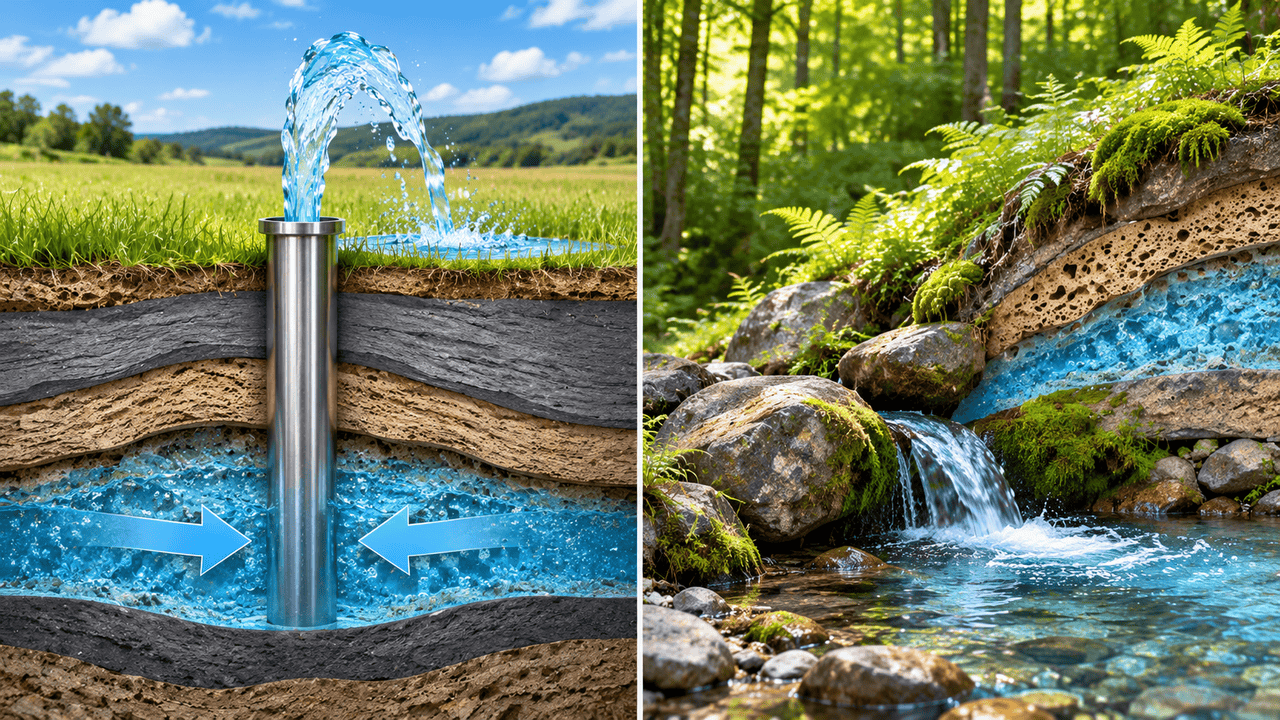
Artesian water is groundwater collected from a well that pierces a confined aquifer. A confined aquifer is an underground water-bearing formation sequestered between layers of poorly permeable material, with shale and dense clay being the most common confining strata. According to the USGS Groundwater Glossary, a confined aquifer is under pressure significantly greater than atmospheric pressure. When a well is drilled into that formation, the hydraulic head built up by the weight of the overlying rock forces water to rise above the top of the aquifer. In highly pressurized systems, the water climbs all the way to the land surface without any mechanical assistance, producing what geologists call a flowing artesian well.
The mechanics are worth understanding because the word “artesian” carries a lot of marketing weight it has not necessarily earned. A few key characteristics define artesian wells and their history:
- Natural Artesian Pressure: The mass of the overlying rock formation acts as a continuous natural pump, driving water upward through the well bore purely through confined hydraulic pressure.
- Flowing Artesian Wells: Where subsurface pressure is high enough, water rises to the land surface and flows freely without any pump infrastructure, creating a self-discharging system that requires no mechanical energy input.
- The term “artesian” traces back to the town of Artois in France, historically recorded as Artesium, where monks drilled vigorously flowing wells during the Middle Ages, per the USGS Artesian Water and Artesian Wells resource. The geological principle they stumbled onto has carried that regional name ever since.
Mountain Park Spring Water: Delivered to Your Porch, Not Shipped Across an Ocean
Many of the artesian-labeled brands lining retail shelves are sourced from aquifers in Fiji, Iceland, or New Zealand and shipped thousands of miles in single-use plastic bottles before they reach a grocery store cooler. The carbon footprint is considerable, and the price reflects every mile of that journey. Mountain Park Spring Water takes a different approach. We keep things local. Family-owned and operated since 1979, with roots stretching back to 1866 when Dr. George Adcock Carter, great-grandfather of current owner Stewart Douglas, began delivering bottled spring water in the Danville, Virginia area, Mountain Park draws from local protected springs and delivers directly to homes and offices across North Carolina and Virginia, with no delivery fees and no fuel surcharges.
Here’s what one customer had to say:
“Mountain Park Spring Water has exceeded all of our expectations. From my first interaction with them I felt like I was talking to a friend. Their customer service is top notch. The process from ordering to delivery to payment is very streamlined and easy. And the water! It is the most delicious water I have ever had. I’ve recently added a bottle to my monthly order because we are going through it so fast. Top marks for this company. Would highly recommend them to anyone looking for a water delivery service!” – Karen Cooper
What Is Spring Water and Nature’s Filtration Journey?
[Inline Image]PLACEHOLDER A natural spring emerging from a rocky Blue Ridge hillside, water cascading over moss-covered stone into a clear pool below. Soft natural light filters through overhanging hardwood canopy, casting dappled reflections on the water surface. The composition emphasizes the geological layering of exposed bedrock, with visible strata suggesting deep underground origins. Photorealistic style, warm earthy tones, serene and pristine atmosphere.[/Inline Image]
Spring water is defined as water derived from an underground formation from which water flows naturally to the Earth’s surface. Where artesian water is pushed upward by confined pressure, spring water follows gravity: it moves through underground rock formations and emerges where the water table intersects the terrain, either at a hillside seep or a valley floor discharge point. That journey through bedrock and subterranean sand constitutes a natural filtration process. It works like a series of gentle sieves, catching impurities while keeping the good stuff your body truly needs, shaping the natural mineral composition of water in ways no industrial treatment system fully replicates. Calcium and magnesium are the most common minerals acquired during this passage, but the exact profile depends on the lithology of the specific formation. Limestone-dominant aquifers tend to produce harder, more mineral-forward water than granite-based ones. Gravity does all the work.
Federal regulations governing spring water collection are more stringent than most consumers realize. The FDA Consumer Update on Bottled Water mandates that spring water must be harvested either directly at the natural spring opening or through a borehole tapping the underground formation that feeds the spring. If a pump or external force is used to draw water through that borehole, the collected water must maintain the exact same physical composition, quality, and characteristics as the water that flows naturally to the surface. This requirement closes a loophole where a producer might drill near a spring, pump out whatever groundwater is available, and label it as spring water. The bottled product must be chemically and physically identical to the natural flow. Standards are high.
The benefits that distinguish spring water in practice come from that combination of natural filtration and regulatory specificity:
- Active Hydrological Flow: Spring water represents a continuously replenished, gravity-driven water cycle: not a static reservoir tapped by a well, but an actively moving system that has been naturally filtering for years before it reaches the surface.
- Rich Mineral Profile: The underground passage through bedrock naturally imparts calcium, magnesium, and zinc, among other trace elements, giving spring water its characteristic taste and contributing to daily mineral intake.
- Crisp, Clean Taste: Filtration through successive rock layers removes suspended particulates and organic matter, producing a clean, refreshing flavor profile without the chemical aftertaste associated with heavily chlorinated municipal supplies.
“Dr. George Adcock Carter, my great-grandfather, began selling and delivering bottled spring water in the Danville, Va area in 1866” – Stewart Douglas, owner of Mountain Park Spring Water
Comparing Artesian and Spring Water: Health, Minerals, and Purity
The premium pricing attached to many artesian-branded waters rests on a geological classification that carries no inherent health advantage. According to USGS Artesian Water and Artesian Wells, “artesian” is strictly a geological descriptor referring to underground pressure conditions: it says nothing about the purity, mineral content, or cleanliness of the water itself. Both artesian and spring waters originate from protected underground aquifers, which is the actual source of their quality advantage over surface-derived municipal water. The confined pressure that defines an artesian well does not filter the water more thoroughly, add beneficial minerals, or reduce contaminant risk beyond what any well-managed aquifer already provides.
Taste and mineral content in both water types are highly localized. An artesian source in one region may produce soft, lightly mineralized water, while a spring in a neighboring county draws from limestone-rich geology and delivers a noticeably harder, more calcium-forward product. Neither is objectively superior; they are simply different expressions of their respective geological environments. Geography shapes the taste. Consumers who choose one over the other based on a label are often paying for geography and marketing rather than a measurable difference in what ends up in the glass.
There’s also a reasonable case to be made that spring water’s regulatory definition is, in some respects, more demanding than artesian’s. The FDA’s spring water standard requires that the bottled product match the natural surface flow in physical composition and quality, a constraint that keeps the bottled version tethered to the actual spring. Artesian well water must come from a confined aquifer under pressure, but the regulation does not require the same compositional congruence to a naturally occurring surface flow. Whether that distinction matters to a given consumer depends on what they value: the geological novelty of pressurized extraction, or the direct continuity with a naturally surfacing water source. Both have unique traits.
[Inline Image]PLACEHOLDER A clean, educational side-by-side geological cross-section diagram. Left panel shows an artesian well penetrating a confined aquifer sandwiched between impermeable shale layers, with arrows indicating upward water pressure through the well bore. Right panel shows a gravity-fed natural spring where a water-bearing formation intersects a hillside, with water flowing freely to the surface. Both panels rendered in a precise technical illustration style with muted earth tones, including ochre, slate blue, and warm grey, on a white background. Labels are minimal and clean.[/Inline Image]
Skip the Single-Use Bottles: Get Fresh Spring Water Delivered
If this comparison has you reconsidering the imported artesian bottles stacking up in your recycling bin, Mountain Park Spring Water offers a practical alternative. Their 5-gallon spring water delivery service brings locally sourced, naturally filtered spring water directly to homes and offices across North Carolina and Virginia, with no delivery fees and no fuel surcharges. Reusable 5-gallon jugs eliminate the single-use plastic waste that comes with retail bottles, and the water itself comes from protected local springs rather than a distant aquifer on another continent.
Here’s what a long-term customer shared about the experience:
“Overall great company. Multiple ways to order and get refill updates via email, text or phone call. Pricing is very fair and they’ve never missed a delivery after more than a year of service. Highly recommended” – Brian Huff
Regulatory Standards and Bottled Water Safety
The regulatory framework governing bottled water in the United States is more rigorous than the casual consumer typically assumes. Three pillars define how both artesian and spring water producers must operate:
- FDA Standards of Identity: The FDA Safety of Bottled Water regulates bottled water under the Federal Food, Drug, and Cosmetic Act, establishing strict standards of identity that legally define what may be labeled as “spring water,” “artesian water,” “purified water,” and other categories. Producers cannot use these terms interchangeably or loosely.
- Testing Frequency: Per the EPA Bottled Water FAQ, bottlers must test their source water and finished products at least once a week for microbiological contaminants and at least once a year for physical, chemical, and radiological contaminants. That cadence applies regardless of whether the source is an artesian well or a natural spring.
- Unregulated marketing terms like “mountain water” or “glacier water” carry no legal definition and are not subject to source verification requirements, unlike “spring” and “artesian,” which are federally defined standards of identity. A bottle labeled “mountain water” could legally come from a municipal tap that has been further purified.
The geographic dimension of bottled water regulation adds another layer worth understanding. The FDA’s oversight applies primarily to bottled water sold in interstate commerce. Brands produced, bottled, and distributed entirely within a single state, as is the case for many regional providers in North Carolina and Virginia, fall under state-specific health department standards and local jurisdictional approval processes for new water sources. For residents in the Piedmont Triad region, including Winston-Salem, Greensboro, and High Point, local groundwater quality is shaped by regional geological formations that can also be affected by agricultural runoff, industrial activity, or aging septic infrastructure. Choosing a source-verified local provider means the water has been sampled, analyzed, and bottled under sanitary conditions aligned with both state licensing requirements and FDA Current Good Manufacturing Practices, known as CGMPs, a dual compliance layer that protects consumers from contaminants specific to their regional environment while supporting a community-rooted family business.
To help you make the most informed decision for your household, we’ve compiled answers to some of the most common questions about these natural water sources.
Frequently Asked Questions About Artesian and Spring Water
What is the healthiest type of water to drink?
Generally, purified or filtered tap water is considered the healthiest option, as it is free from contaminants while retaining essential minerals, provided it meets local safety standards. That said, natural spring water that undergoes rigorous independent testing and careful disinfection, such as ozonation rather than chlorination, offers an excellent, mineral-rich alternative without the chemical taste that some municipal tap water carries. The honest answer is that “healthiest” depends heavily on what your local tap water contains and how a given bottled water is sourced and treated.
Is artesian water good for kidneys?
Artesian water is safe for the kidneys for most people. Individuals managing specific kidney conditions, however, should pay attention to the mineral content of their chosen source, since elevated levels of calcium or sodium in certain artesian supplies could be a factor depending on the aquifer’s geology. If kidney health is a concern, reviewing the water quality report from your specific provider is a more useful step than choosing based on the label category alone.
What are the disadvantages of artesian wells?
The main disadvantages involve both infrastructure and water quality variables. Drilling and maintaining an artesian well carries significant upfront cost, and if the wellhead casing is damaged, surface runoff can infiltrate the confined aquifer and introduce contaminants. Some artesian sources also produce water with high mineral hardness, which can affect taste and create scaling in plumbing. Over time, heavy extraction from a confined aquifer without adequate recharge can exhaust the source: a risk that is less pronounced with naturally flowing springs connected to active hydrological cycles.
Can you drink natural artesian water?
Yes, provided the water has been properly tested and treated to confirm it is free from harmful bacteria, parasites, and chemical contaminants. The geological classification alone does not guarantee safety: an artesian well in an area with compromised surface geology or industrial contamination requires the same rigorous testing as any other groundwater source. Regulatory compliance and independent water quality verification matter more than the label.
What is the unhealthiest bottled water to drink?
Bottled waters that are highly acidic, contain added sugars or artificial flavorings, or are packaged in low-quality plastics that may leach compounds like BPA or phthalates when exposed to heat are generally the most problematic options. The container matters as much as the contents; water stored in thin, low-grade plastic bottles left in a hot car or warehouse can absorb chemical residues from the packaging itself, regardless of how clean the source water was at the time of bottling.
Both artesian and spring water are legitimate, high-quality groundwater sources. The geological distinction between them is real, but the health hierarchy that marketing implies is not. What truly determines the quality of your water is the specific aquifer it comes from, the rock formations it travels through, the rigor of the testing protocol applied to it, and the care taken during bottling and delivery. For households in North Carolina and Virginia looking for a dependable, locally sourced alternative to retail bottles, Mountain Park Spring Water has been providing exactly that since 1979: drawing from protected springs, delivering in reusable 5-gallon jugs, and standing behind every drop with the kind of service that a family business with roots going back to 1866 tends to take personally.
Ready to Make the Switch? Mountain Park Spring Water Delivers to Your Door
Mountain Park Spring Water serves Winston-Salem, Greensboro, High Point, and communities throughout North Carolina and Virginia. Reach them at 2835 Lowery Street or by phone at 336-761-0884. There are no delivery fees and no fuel surcharges: just fresh, locally sourced spring water brought straight to your home or office on a schedule that works for you.
Here’s what one customer experienced firsthand:
“After dealing with two other delivery services for water and both were a frustrating nightmare to deal with I contacted Mountain Park and the difference in service was night and day. They were friendly, caring, and the entire process was a breath of fresh air (and water ). Jonathan delivered our water today and he was extremely friendly, went over the process with me and also let me know that when they deliver they only replace and charge for whatever number of empty bottles as they would not want us to pay for what we didn’t need. He even brought them into the house and placed them on our bottle rack. It is exactly how any delivery service should be. The fact they are local and family owned just adds to our satisfaction. If you’re still not sure, just trust me and call them. They are a joy to work with. I mean just look at the five star reviews. Almost 200 people so far have said the same experience. It’s just delightful to finally find a company that truly understands that it’s not just the water, but the delivery that mat” – Wayne Gibson