Total Dissolved Solids (TDS) represents the combined concentration of dissolved inorganic substances, minerals, and other compounds present in water, per the EPA Secondary Drinking Water Standards. These substances, including calcium, magnesium, potassium, salts, and carbonates, dissolve completely and become invisible to the naked eye while remaining fully active in the liquid.
Think of stirring a spoonful of sugar into a warm glass of sweet tea. The crystals vanish quickly, but they are still there, changing the taste and body of the drink. Dissolved solids in water work the same way: you cannot see them, but they influence everything from flavor to how your appliances hold up over time. They hide in plain sight.
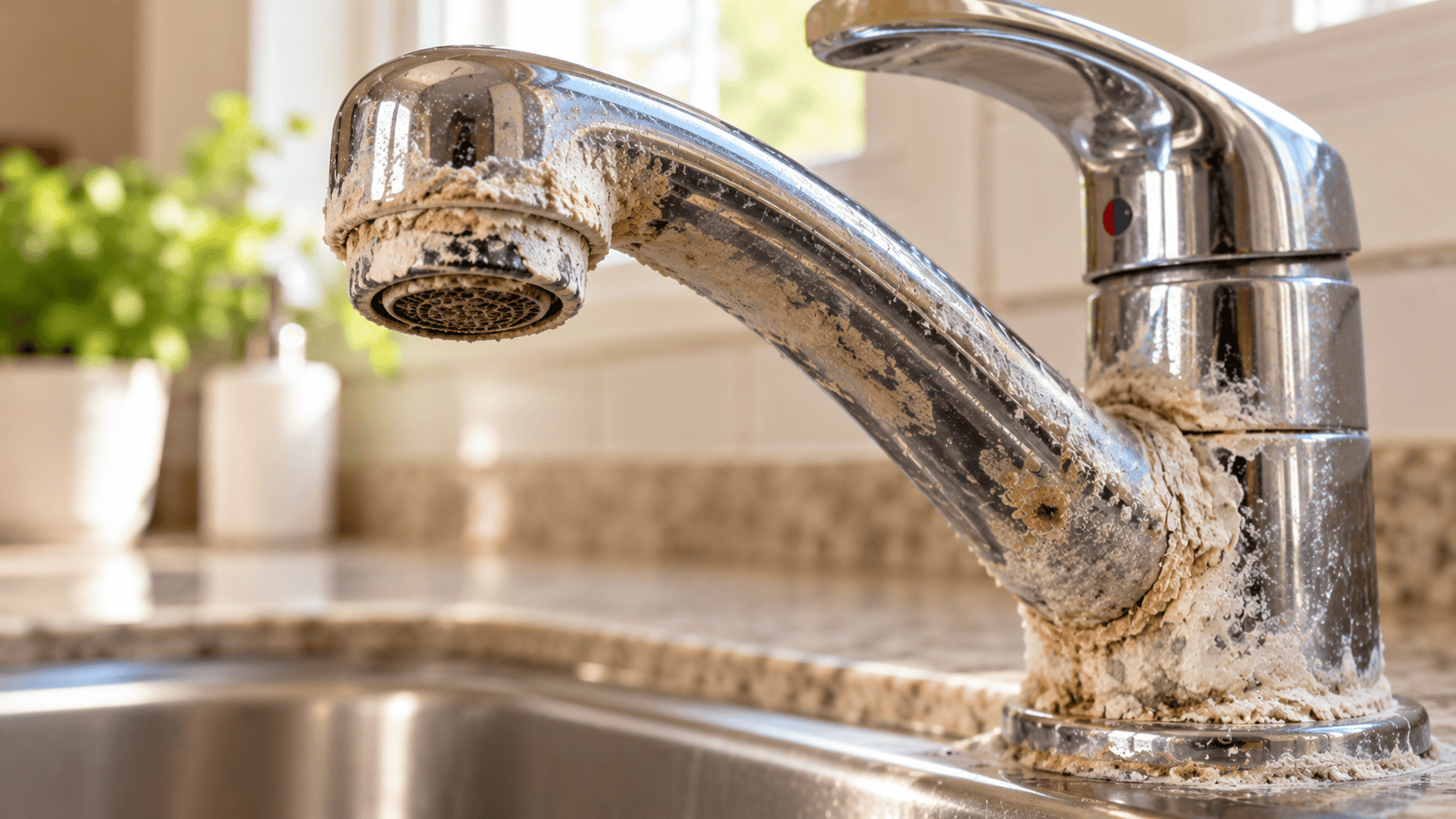
Most people encounter this term after noticing white spots on clean dishes, a chalky crust forming around the kitchen faucet, or a faintly salty edge to their morning coffee. Solving it does not require a chemistry degree or a weekend of plumbing work, and understanding it helps you get clean water without the typical headaches. For context on what water looks like at the opposite end of the mineral spectrum, it helps to understand purified water: water that has gone through advanced filtration to strip the heavy dissolved load down to near zero.
Understanding Total Dissolved Solids in Water
Total dissolved solids represent the combined weight of all organic and inorganic substances in a liquid that can pass through a microscopic filter. In practical terms, that means calcium, magnesium, potassium, sodium, carbonates, chlorides, and sulfates: the mineral fingerprint left by the geology a water source travels through before it reaches your tap. A mountain aquifer and a municipal treatment plant will produce very different TDS profiles, even if both deliver water that looks crystal clear in the glass.
Knowing the TDS of your water matters because it serves as a primary indicator of overall water quality and aesthetic character. A high reading tells you the water is carrying a heavy dissolved load, though it cannot tell you exactly what that load consists of. That distinction is worth holding onto: TDS is an aggregate measure, not a contaminant inventory. It measures quantity, not safety.
A TDS meter, sometimes called a TDS tester, measures the electrical conductivity of water. Pure water conducts electricity poorly; dissolved minerals and salts increase conductivity because they carry electrical charges. The meter detects that current and converts it into a number expressed in milligrams per liter (mg/L) or parts per million (ppm). What the meter cannot do is pinpoint which specific minerals are present. A reading of 350 ppm from a well-mineralized spring and 350 ppm from a poorly treated municipal supply can represent very different water chemistry: the number alone does not tell the whole story.
What Is a Good TDS Level for Drinking Water?
The EPA regulates drinking water through two distinct frameworks. National Primary Drinking Water Regulations are legally enforceable standards that protect public health by limiting contaminant levels. National Secondary Drinking Water Regulations are non-enforceable guidelines that manage aesthetic and cosmetic effects, such as taste, color, and odor, per the EPA Drinking Water Regulations and Contaminants. TDS falls under the secondary category with a Secondary Maximum Contaminant Level (SMCL) of 500 mg/L (per EPA Drinking Water Regulations and Contaminants).
That 500 mg/L threshold is the EPA’s upper boundary for palatability. It is a simple guide. Water below it is generally free from the mineral deposits, scaling, and salty tastes that make tap water unpleasant to drink or cook with. For a side-by-side look at where different water types land relative to this standard, the spring water vs. purified water comparison at Mountain Park is a useful reference.
- Aesthetic Limit: Levels at or below 500 mg/L are generally free from noticeable mineral deposits, scaling, and salty tastes, making the water very pleasant for daily drinking (per EPA Secondary Drinking Water Standards).
- High-TDS Threshold: When TDS exceeds 500 mg/L, consumers may notice a salty taste, water hardness, mineral deposits, staining, or discolored water (per EPA Secondary Drinking Water Standards).
- Is high TDS water safe to drink? Because TDS is a secondary standard, elevated levels do not present a direct risk to human health at their set SMCLs (per EPA Secondary Drinking Water Standards). However, very high levels can cause water to appear cloudy or colored, or to taste and smell bad, which often drives people away from perfectly safe public water systems, even when those systems are meeting all primary health standards (per EPA Secondary Drinking Water Standards).
- Related secondary contaminants: Chloride carries an SMCL of 250 mg/L and produces a salty taste. Sulfate shares that same 250 mg/L limit with a similar effect. Iron’s SMCL sits at 0.3 mg/L, producing rusty color, sediment, metallic taste, and reddish-orange staining. Manganese registers at 0.05 mg/L, causing black-brown discoloration, black staining, and a bitter metallic taste (per EPA Secondary Drinking Water Standards).
If you are tired of dealing with hard, high-TDS tap water that leaves spots on your glasses and tastes metallic, Mountain Park Spring Water has been delivering pure, refreshing water straight to porches since 1979, carrying on a family tradition that Stewart Douglas’s great-grandfather started back in 1866. We never charge delivery fees or fuel surcharges, so what you see is exactly what you pay. Explore our 5-gallon purified water delivery or our ultra-pure 5-gallon distilled water delivery, available across Winston-Salem, Greensboro, High Point, North Carolina, and Virginia.
The Impact of High TDS on Water Quality and Your Home
Water with elevated dissolved solids can quietly erode the experience of everyday home life. It makes water taste bitter, salty, or metallic. It leaves a dull film on glassware and cutlery that persists even after a thorough wash, and it dulls the flavor of anything cooked or brewed with it, such as a pot of coffee, a batch of pasta, or a simple cup of tea. The effect is subtle enough that many households adjust to it without realizing their water is the culprit.
The technical consequences are harder to ignore over time. Scale builds up silently. High TDS levels are linked to scaling, which is a tough mineral deposit that accumulates inside hot water pipes, boilers, and heat exchangers, gradually restricting or blocking water flow (per EPA Secondary Drinking Water Standards). That buildup forces water heaters to work harder to reach temperature, shortens the service life of washing machines and dishwashers, and can eventually require costly plumbing repairs. The minerals responsible for that scale are the same ones driving your TDS reading upward.
State and local authorities take dissolved substances seriously for exactly these reasons. While federal secondary standards are non-enforceable guidelines, individual states have the authority to adopt them as enforceable standards or establish their own local water quality criteria (per EPA Drinking Water Regulations and Contaminants). North Carolina, for example, runs detailed water quality assessments every two years under Sections 303(d) and 305(b) of the Clean Water Act, comparing thousands of surface water samples against state standards to identify and manage impaired waterbodies (per the North Carolina Department of Environmental Quality). Waterbodies that consistently exceed those standards are classified as impaired, and Category 5 cases require a Total Maximum Daily Load plan submitted to the EPA. That level of monitoring reflects how directly regional dissolved-solid concentrations affect residents in Winston-Salem, Greensboro, and High Point.
- Appliance lifespan: High TDS accelerates wear on water-using appliances through mineral accumulation in heating elements and internal lines (per EPA Secondary Drinking Water Standards).
- Taste degradation: Dissolved minerals alter the flavor of drinking water and cooked foods, often producing a flat, metallic, or brackish character, a point explored in depth when you look at how minerals in drinking water shape the taste and mouthfeel of what you drink.
- Over time, scaling can constrict pipes enough to require full section replacements, turning what started as a water quality annoyance into a significant plumbing expense (per EPA Secondary Drinking Water Standards).
“Dr. George Adcock Carter, my great-grandfather, began selling and delivering bottled spring water in the Danville, VA area in 1866.” – Stewart Douglas, owner of Mountain Park Spring Water
How to Lower TDS in Water: Filtration and Treatment Options
A common belief is that a standard pitcher filter or a basic under-sink carbon block will solve a high-TDS problem. Conventional water treatments, such as coagulation, flocculation, and standard filtration, are effective at removing suspended metals like iron, manganese, and zinc, but they are generally ineffective at removing dissolved solids (per EPA Secondary Drinking Water Standards). Carbon-based filters are designed to reduce chlorine, sediment, and certain taste and odor compounds. They do not strip dissolved mineral ions from the water, so the TDS reading stays essentially unchanged after the water passes through them. The minerals remain.
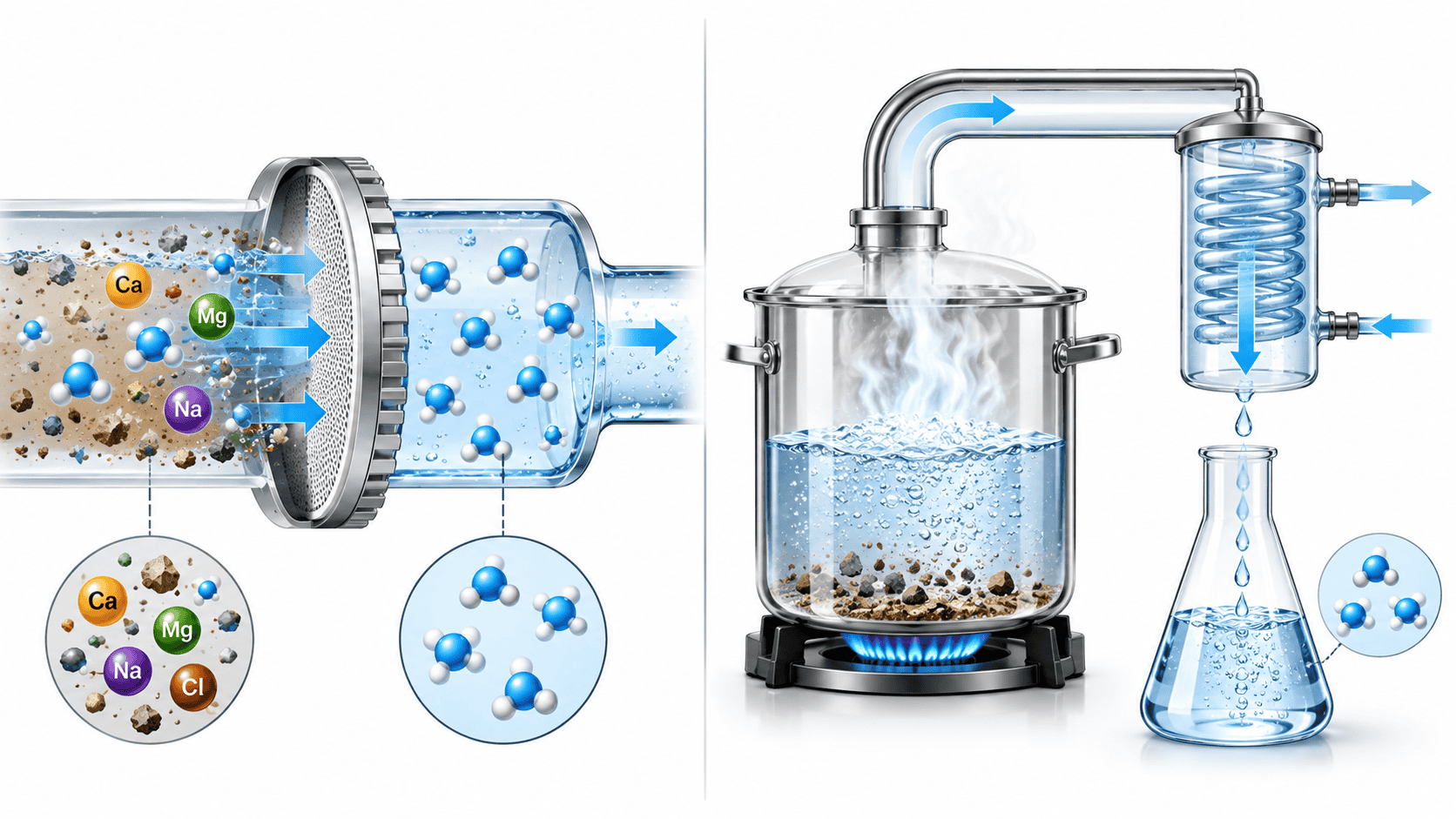
Reducing TDS requires non-conventional treatment technologies that work at the molecular level, physically separating dissolved inorganic substances from water molecules rather than simply trapping particles. Reverse osmosis, steam distillation, and electrodialysis are the methods that move the needle on a TDS reading.
Installing and maintaining advanced treatment systems at home can be expensive and complicated. Reverse osmosis membranes require periodic replacement, the lines need sanitizing, and the systems produce wastewater as a byproduct. A whole-house distillation setup requires even more infrastructure. Many families and businesses across North Carolina and Virginia find it far more practical to skip the upfront costs and ongoing maintenance entirely. Mountain Park Spring Water handles all of that work on our end, using professional, state-of-the-art purification and steam distillation processes to ensure exceptional quality in every delivery. Our 5-gallon purified water delivery and 5-gallon distilled water delivery options bring low-TDS water straight to your porch, with honest pricing, friendly local drivers, and no surprise fees of any kind.
Effective Technologies for Reducing Dissolved Solids
Three non-conventional treatment methods have proven highly effective at reducing TDS to significantly lower levels:
- Reverse Osmosis (RO): Forces water through a semi-permeable membrane under high pressure, leaving dissolved solids behind and producing highly purified water (per EPA Secondary Drinking Water Standards).
- Steam Distillation: Heats water to its boiling point, converting it to steam and leaving all heavy minerals, salts, and dissolved solids in the boiling chamber. The steam condenses back into pure liquid water with a dramatically reduced TDS level (per EPA Secondary Drinking Water Standards).
- For a deeper look at how these methods work alongside other clean water technologies, the article on water purification systems covers the technical mechanics in detail.
- Electrodialysis: Uses electrical currents to separate dissolved ions from water. Highly effective, but typically reserved for larger industrial or municipal applications rather than residential use (per EPA Secondary Drinking Water Standards).
All three of these technologies are genuinely effective at removing total dissolved solids and other inorganic substances. The challenge is cost and practicality. Smaller public water systems and individual homeowners often find these treatments expensive to install and hard to maintain over time (per EPA Secondary Drinking Water Standards). That gap between what the technology can do and what most households can realistically sustain is exactly why many families across North Carolina and Virginia choose to bypass home filtration systems entirely and rely on professional delivery instead.
Frequently Asked Questions About TDS in Water
What is a good TDS value for water?
Generally, a TDS level between 50 and 300 mg/L is considered excellent for drinking water. Levels below 50 are often considered low, while levels above 500 mg/L are typically viewed as the upper limit for palatability (per EPA Drinking Water Regulations and Contaminants). Choosing low-TDS water consistently improves daily hydration: for a fuller picture of what that looks like in practice, the purified water benefits comparison between tap and purified water is worth reading.
Is TDS in water good for you?
TDS consists of minerals, salts, and metals. Some dissolved minerals like calcium and magnesium are good for the human body, while other dissolved substances can be harmful. Whether a TDS reading is good or bad depends entirely on the specific chemical composition of the substances making up that reading, not just the total number itself. A high reading from calcium-rich spring water is a very different situation from a high reading driven by chloride and sulfate accumulation.
Do filters reduce TDS?
It depends entirely on the filter type. Reverse osmosis systems and distillation processes significantly reduce TDS by physically separating dissolved inorganic substances from water molecules (per EPA Secondary Drinking Water Standards). Standard carbon-based filters, like most basic pitcher filters, are designed to remove chlorine and sediment to improve taste, but they typically have little to no effect on TDS levels.
How do you reduce TDS in water?
The most effective methods are reverse osmosis filtration, steam distillation, and electrodialysis (per EPA Secondary Drinking Water Standards). These non-conventional approaches physically remove dissolved solids from the water, resulting in a much lower, cleaner reading. Boiling water, by contrast, concentrates dissolved solids as water evaporates, so it moves the TDS reading in the wrong direction.
Do Brita filters reduce TDS?
No, standard Brita filters are designed to improve taste and odor by reducing chlorine, copper, mercury, and cadmium. They do not greatly lower TDS because they do not remove the dissolved minerals and salts that make up the bulk of the reading. If your concern is a high TDS number, a Brita pitcher will not address it.
Contact Us to Get Started Today
Understanding what TDS means in water is the first practical step toward taking control of your home’s water quality. High TDS levels do not pose a direct health threat, but they can ruin the taste of your morning coffee, leave frustrating mineral deposits on clean dishes, and cause long-term scaling damage to plumbing and appliances. You do not have to spend thousands of dollars on complex under-sink filtration systems or spend your weekends replacing dirty membranes to get genuinely clean water.
Since 1979, the family at Mountain Park Spring Water has been helping neighbors across Winston-Salem, Greensboro, High Point, North Carolina, and Virginia enjoy pure, low-TDS water without any of the hassle. Our neighbors have noticed the difference:
“Mountain Park Spring Water has exceeded all of our expectations. From my first interaction with them, I felt like I was talking to a friend. Their customer service is top-notch. The process from ordering to delivery to payment is very streamlined and easy. And the water! It is the most delicious water I have ever had. I’ve recently added a bottle to my monthly order because we are going through it so fast. Top marks for this company. Would highly recommend them to anyone looking for a water delivery service!” – Karen Cooper
“Overall great company. Multiple ways to order and get refill updates via email, text, or phone call. Pricing is very fair, and they’ve never missed a delivery after more than a year of service. Highly recommended.” – Brian Huff
“After dealing with two other delivery services for water and both were a frustrating nightmare to deal with, I contacted Mountain Park, and the difference in service was night and day. They were friendly, caring, and the entire process was a breath of fresh air (and water ). Jonathan delivered our water today, and he was extremely friendly, went over the process with me, and also let me know that when they deliver, they only replace and charge for whatever number of empty bottles, as they would not want us to pay for what we didn’t need. He even brought them into the house and placed them on our bottle rack. It is exactly how any delivery service should be. The fact that they are local and family-owned just adds to our satisfaction. If you’re still not sure, just trust me and call them. They are a joy to work with. I mean, just look at the five-star reviews. Almost 200 people so far have said the same experience. It’s just delightful to finally find a company that truly understands that it’s not just the water, but the delivery that matters.” – Wayne Gibson
Ready to experience the difference that pure, low-TDS water can make in your home or office? View our clear water delivery costs today to find the right plan for your household. Give Stewart or Robert Douglas a call at 336-761-0884, or visit us at 2835 Lowery Street to get started. We have been delivering quality since 1866, and we still promise no delivery fees, no fuel surcharges, and no surprise fees: just honest, friendly service from our family to yours.